
UL/FM Certified Gate Valves vs. Butterfly Valves: A Selection Guide for Fire Protection Contractors
A practical technical comparison of gate valves and butterfly valves for fire protection piping systems, covering functional design, pressure drop, certification compliance, and installation considerations for UL/FM certified applications.
King Panda Engineering Team
Product selection, submittal data and installation support for fire protection contractors and distributors
Fire protection piping systems demand components that perform reliably under extreme conditions while meeting strict certification requirements. Among the most common decisions fire protection contractors face is selecting between gate valves and butterfly valves — two fundamentally different designs that serve distinct roles within a fire suppression system. Both types are available with UL Listed and FM Approved certifications, but their mechanical characteristics, installation requirements, and operational suitability diverge significantly across application scenarios. This guide breaks down the technical differences and provides a practical framework for specifying the correct valve type in fire pipeline systems.
| Aspect | Gate Valve | Butterfly Valve |
|---|---|---|
| Design | Wedge lifts clear of the bore | Rotating disc remains in the flow path |
| Pressure loss, fully open | About 0.1 to 0.3 ft of head | About 0.5 to 2.0 ft of head in 2 to 12 in. sizes |
| Face-to-face dimension, 12 in. | 30 in. or more | 4 to 6 in. |
| Operation | Multiple turns for open or closed | Quarter turn, can be actuated |
| Preferred use | Mainline isolation with infrequent operation | Space-constrained or frequently operated points |

Functional Design and Operating Principles
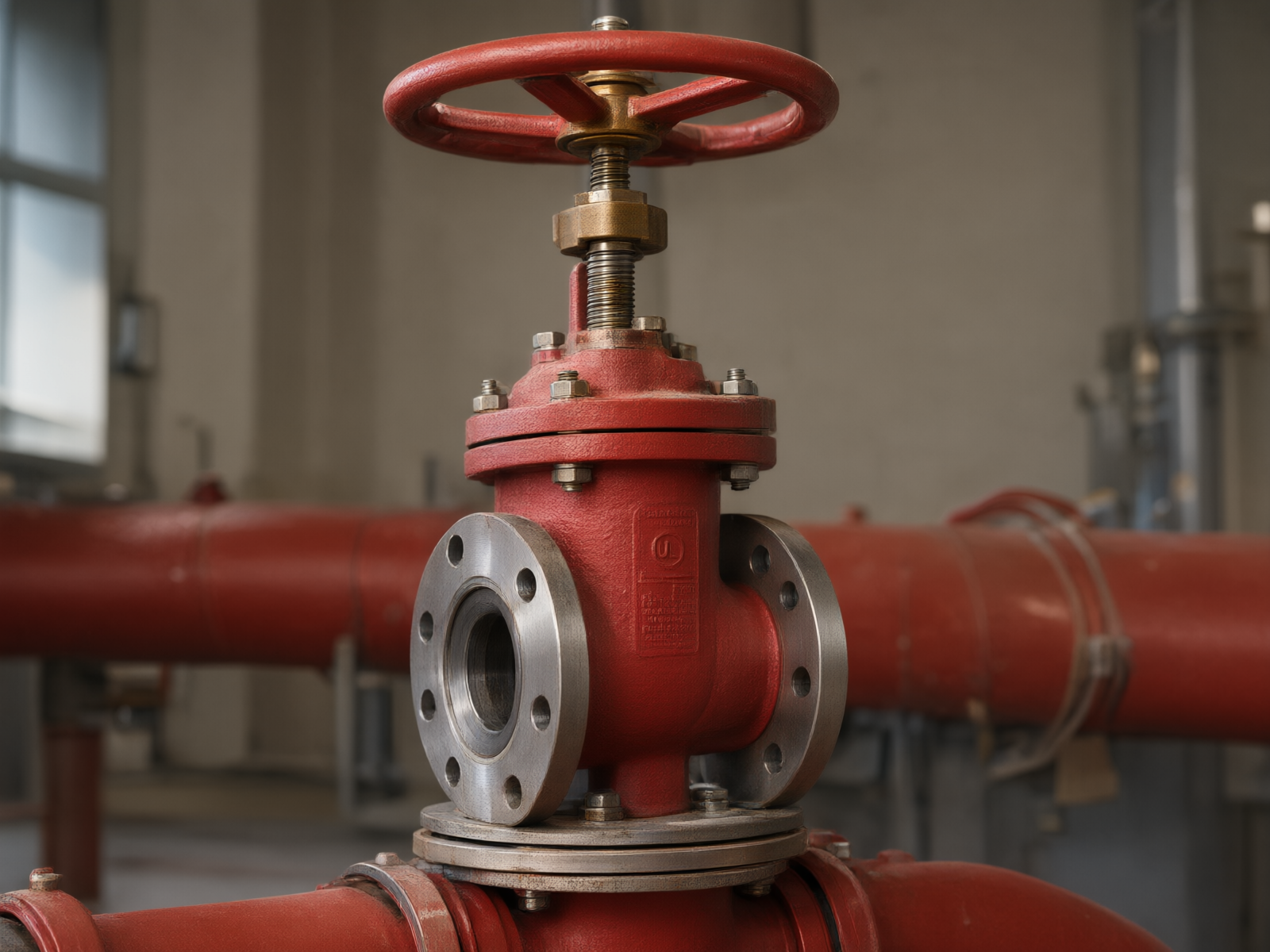
Gate valves operate through a rising or non-rising stem mechanism that lifts a solid wedge (the “gate”) perpendicular to the flow path. When fully open, the gate retracts completely above the bore, creating an unobstructed passage with minimal pressure drop. This full-bore design makes gate valves the standard choice for on/off isolation in fire main lines, where the objective is to either permit full flow or shut it down entirely — not to modulate it.
Butterfly valves use a rotating disc mounted on a shaft through the center of the valve body. A quarter-turn (90 degrees) moves the disc from fully open (parallel to flow) to fully closed (perpendicular to flow). The disc remains in the flow stream at all positions, which introduces a measurable pressure drop even in the open state. This compact design trades flow efficiency for space savings and faster actuation.
The distinction matters in fire system design: gate valves are preferred where hydraulic calculations require minimal friction loss, while butterfly valves are acceptable where space constraints or actuation speed take priority and the system’s hydraulic model accounts for the disc’s presence.
Size Range and Space Constraints
Gate valves are manufactured in sizes ranging from 2 inches to 24 inches and beyond, with UL/FM listed models commonly available up to 16 inches. Their physical length — the face-to-face dimension — increases proportionally with bore size. A 12-inch gate valve may require 30 inches or more of linear pipe space, plus additional clearance above the body for stem travel in rising-stem configurations. In pump rooms and riser rooms where piping runs are dense, this footprint becomes a real constraint.
Butterfly valves in the same size range occupy a fraction of that space. A 12-inch butterfly valve typically has a face-to-face dimension of 4 to 6 inches, with no vertical clearance requirement for stem movement. For contractors working in tight mechanical rooms, high-rise riser chases, or retrofit projects where existing infrastructure limits available space, butterfly valves offer a clear installation advantage.

However, the space savings come with a trade-off in larger sizes. Above 12 inches, butterfly valves become heavier relative to their bore size due to the disc and seat mechanism, and the torque required for manual operation increases. In these sizes, gear operators or powered actuators are typically necessary regardless of valve type.
Pressure Drop and Hydraulic Performance
In fire protection systems, hydraulic calculations determine whether water supply is adequate to deliver the required flow rate at the most remote sprinkler or standpipe outlet. Every component in the pipeline introduces friction loss, and valves are no exception.
A fully open gate valve produces a pressure drop equivalent to roughly 0.1 to 0.3 feet of head loss per valve, depending on size — essentially negligible in most system calculations. This is why fire protection engineers routinely specify gate valves for mainline isolation points, cross-connection control, and connections to fire department outlets, where preserving available pressure is a priority.
A fully open butterfly valve produces a higher pressure drop — typically 0.5 to 2.0 feet of head loss in common sizes (2 to 12 inches), because the disc disrupts flow even in the open position. In systems operating near the minimum required pressure at the design point, this difference can affect whether the system passes hydraulic calculations or requires upsizing the supply line. Contractors should consult the manufacturer’s published Cv values and include butterfly valve losses explicitly in hydraulic models rather than treating them as equivalent to gate valves.
Certification Compliance and Code Acceptance
Both gate valves and butterfly valves used in fire protection systems must carry UL Listed or FM Approved certification for the specific service in which they are installed. NFPA 13 (Standard for the Installation of Sprinkler Systems) and NFPA 14 (Standard for the Installation of Standpipe and Hose Systems) require that all control valves be listed for fire protection service.
UL Listed gate valves for fire protection service conform to UL 262, while FM Approved models meet FM 1120. Butterfly valves are listed under UL 262 as well, but contractors should verify that the listing specifically covers fire protection service — some butterfly valves carry UL listings only for potable water or HVAC applications, which do not satisfy fire code requirements.
Post-indicator valves (OS&Y gate valves with a visible position indicator) remain the default specification for outside stem and yoke applications because the visual indication of open/closed status satisfies NFPA requirements for supervised control valves. Butterfly valves with supervised position switches are an accepted alternative, but the supervisory device must be monitored by the fire alarm system to provide equivalent indication.
Installation and Maintenance Considerations
Gate valves are heavier and require more support in the piping run, particularly in larger sizes. Rising-stem gate valves require vertical clearance for full stem extension, which must be accounted for during layout. Gate valves also take longer to operate — multiple turns are required to go from fully open to fully closed — which makes them unsuitable for applications requiring rapid isolation.
Butterfly valves install quickly, operate with a quarter-turn, and can be fitted with worm-gear operators or electric/pneumatic actuators for remote or automatic operation. Maintenance access is simpler: the disc and seat can often be serviced without removing the valve body from the line (in lug-style configurations). However, the elastomeric seat in a butterfly valve is subject to wear and deformation over time, particularly in systems that cycle frequently or operate at elevated temperatures. Replacement intervals should follow the manufacturer’s recommendations and be documented in the system’s maintenance plan.

For contractors, the practical implication is that gate valves suit locations where the valve will remain in one position for extended periods (typically open) with infrequent operation, while butterfly valves are better suited to locations requiring frequent operation, remote actuation, or space-constrained installation.
Summary and Specification Guidance
The choice between gate valves and butterfly valves in fire protection systems is not a matter of one being universally superior — it is a function of the specific installation requirements at each point in the system. Gate valves provide minimal pressure drop, proven long-term reliability in static positions, and straightforward visual indication. Butterfly valves offer compact installation, rapid operation, and easier actuation integration.
Contractors who understand these differences and apply them systematically — matching valve type to hydraulic requirements, space availability, operational frequency, and code compliance at each location — produce systems that are both code-compliant and cost-efficient. Specifying the wrong type at a critical point can lead to hydraulic failures, costly rework, or inspection deficiencies.
King Panda Technology manufactures UL Listed and FM Approved gate valves and butterfly valves for fire protection service, along with a full range of certified sprinklers and Accessories. For technical specifications, submittal data, or project-specific selection guidance, contact our engineering team for support.
Standards and sources
- NFPA 13, Standard for the Installation of Sprinkler Systems
- NFPA 14, Standard for the Installation of Standpipe and Hose Systems
- UL 262, Fire-Protection Service Valves
- FM 1120, Indicating Valves
Figures in this guide follow the sprinkler discharge equation Q = K√P. Final selection must be verified against the governing listing and the authority having jurisdiction for the project.
Need Help With Fire Protection System Selection?
Our engineering team can provide technical consultation for your warehouse fire protection project.
Contact Our Team